![]() |
![]() |
ISO INFO Newsletters: No. 13-May 1998
|
| PI | Institute | Proposal |
|---|---|---|
| Ehrenfreund, P. | Sterrenwacht Leiden, NL | Spectroscopy of Dust and Ice in MonR2 IRS2 |
| Eriksson, K. | Uppsala Astr. Observatory, S | A Spectrum of the Envelope around the Red Giant R Doradus |
| Forveille, T | Observatoire de Grenoble, F | ISOCAM CVF spectrum of the nearby Brown Dwarf |
| DENIS-P J0205-1159 | ||
| Gorny, S. | N. Copernicus Astronomical | Planetary Nebulae with [WR]-Type Central Stars: |
| Center, Torun, Poland | Transition from O- to C-rich dust composition. | |
| Hough, J. | University of Hertfordshire, UK | Polarimetry of the nucleus of active galaxies: |
| AGN with hidden broadlines and rising IR polarization | ||
| Jourdain de | LAEFF-INTA, Madrid, E | The Remarkable Dust Shell of the B[e] star MWC922: |
| Muizon, M. | ISO discovers strongest olivine bands ever | |
| Klaas, U. | ISO SOC, VILSPA, E | Far Infrared Polarisation of Beta Pictoris |
| Krugel, E. | MPI für Radioastr., Bonn, D | The shape of grains in the normal galaxy N1808 |
| Lagage, P.O. | C.E.A., Saclay, F | Gas and Dust in the Kepler SNR |
| Lemke, D. | MPI für Astronomie, Heidelberg, D | Large-scale Map of the Orion Molecular Cloud/Star |
| Formation Complex at 200 | ||
| Lemke, D. | MPI für Astronomie, Heidelberg, D |
Completion of 175 |
| Malfait, K. | Instituut voor Sterrekunde, | Circumstellar Chemistry of the Main Sequence Star |
| Leuven, B | Beta Pictoris | |
| Martin-Pintado, J. | Observatorio Astronomico | The spatial distribution of the recently discovered |
| Nacional, E | ionized and hot neutral gas in the Galactic Center | |
| Mattila, K. | University of Helsinki | Large-scale Mapping of the Orion-B Molecular Cloud/ |
| Observatory, SF | Star Formation Complex (Lynds 1630) at 200 | |
| Metcalfe, L. | ISO SOC, VILSPA, E | FIR photometry and CAM CVF observations of a |
| disk around BD+31 643 | ||
| Morris, M. | UCLA, USA | Large-Scale Shocks in the Galactic centre and other Regions |
| Morris, P. | ISO SOC, VILSPA, E | The Molecular Content of the WR Nebula NGC2359 |
| Mueller, T. | ISO SOC, VILSPA, E | Polarimetry of Asteroids |
| Pilbratt, G. | SA, ESTEC, NL | SWS spectroscopy of an unknown extended source |
| in the M16 area | ||
| Prusti, T. | ISO SOC, VILSPA, E | Variable infrared emission from circumstellar |
| environment of young intermediate mass stars | ||
| Prusti, T. | ISO SOC, VILSPA, E | Evolution of the circumstellar environment during |
| an FU Ori outburst | ||
| Schutte, W. | Sterrenwacht Leiden, NL |
The 6.2 |
| towards CYGOB2# 12 | ||
| Siebenmorgen, R. | ISO SOC, VILSPA, E | Mid-IR polarimetric imaging of the protostellar |
| candidate HH108MMS | ||
| Stark, R. | MPI für Radioastr., Bonn, D | Density structure and evolutionary state of TMC-1 |
| Stickel, M | MPI für Astronomie, Heidelberg, D | ISOPHOT Follow-up of interesting Serendipity Sources |
| Stringfellow, G. | Center for Astrophysics and Space | Temporal Evolution and Dust Formation(?) in Nova |
| Astr., Univ. of Colorado, USA | Sgr 1998: The ISO Mission Ends with a Bang! | |
| Szczerba, R. | N. Copernicus Astronomical | Infrared carbon stars with OH emission: |
| Center, Torun, Poland | Transition from O- to C-rich stars | |
| Thompson. D. | MPI für Astronomie, Heidelberg, D | Far-Infrared Photometry of an Extremely Red Galaxy |
| Thornley, M. | MPE, Garching, D | The Arches Cluster: Probing the interaction between |
| massive stars and the ISM in the Galactic Center | ||
| Thuan, T. | Univ. of Virginia, Dep. | Dust and infrared emission in the extremely |
| of Astronomy, USA | metal-deficient blue compact galaxy SBS 0335-052 | |
| Trams, N. | ISO SOC, VILSPA, E | The LMC AGB star IRAS04496-6958: A carbon |
| star with silicate dust? | ||
| Unger, S. | IPAC, CalTech, USA | Observations of the SNR 3C58 using the ISO Spectrometers |
| Andre, P. | C.E.A., Saclay, F | Spectral Energy Distribution of a Newly-Discovered |
| Protostar in Taurus | ||
| Barvainis, R. | Haystack Observatory, USA | An Einstein Ring with Strong Submillimeter Emission |
| Bertoldi. F. | MPE, Garching, D |
High H |
| Bregman, J. | University of Michigan, USA | The Origin of Mid-IR Emission from Elliptical Galaxies |
| Castro-Tirado, A. | LAEFF-INTA, Madrid, E | The nature of the superluminal galactic source GRS 1915+105: |
| ISO monitoring of the most powerful source in the Galaxy | ||
| Cernicharo, J. | CSIC, Madrid, E | Discovery of a Dust Jet and a Circumstellar Disk in HH1-2 |
| Cernicharo, J. | CSIC, Madrid, E | Warm Dust around Hot Stars : The Ionizing Source |
| of the Trifid Nebula | ||
| van der Werf, P. | Sterrenwacht Leiden, NL | Stellar population in the z=3.5 radio galaxy |
| 6C1909+722: A genuine primaeval galaxy? | ||
| van Hoof, P. | University of Kentucky, USA | Accurate abundance determination of CNO |
| in PN: An investigation into the t | ||
| Waters, R. | Astronomical Inst. Amsterdam, NL | First Detection of Crystalline Silicates in the LMC: |
| Unravelling the Mass Loss History of R71 | ||
| Waters, R. | Astronomical Inst. Amsterdam, NL | A protoplanetary disk around the Red Rectangle? |
| Wesselius, P. | SRON, Groningen, NL | Follow-up SWS observations on |
| intermediate-mass YSOs | ||
| Wright, C. | Sterrenwacht Leiden, NL | ISOPHOT Polarisation Observations of two |
| Bipolar Outflow Sources | ||
| Zavagno, A. | Obs. Marseille, F | Imaging of a massive star forming region: |
| Study of AFGL4029 |
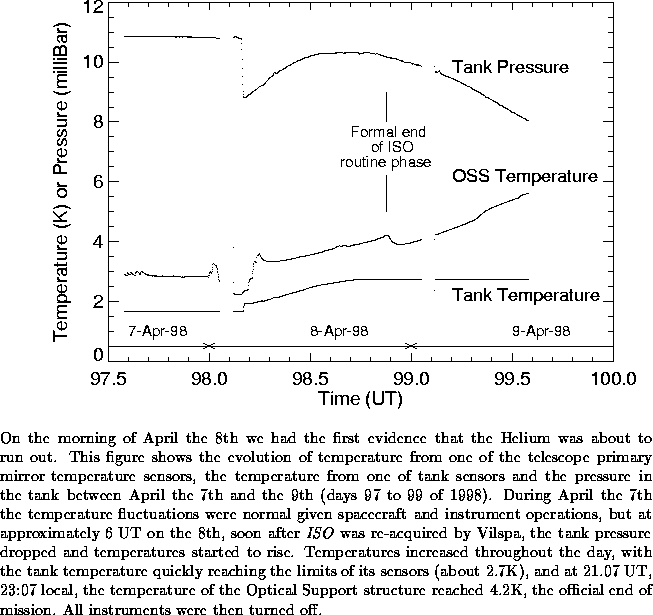
After Helium loss, and prior to the start of the Technology Test Phase, a series of tests were carried out on SWS to verify the proper functioning of its shortest wavelength band 1 detectors (2.36 - 4.08 microns) at the elevated temperatures then being experienced in the cryostat. Despite the focal plane temperature being above nominal, and increasing at the slow rate of about 4 K per day, the band 1 detectors were seen to function properly with only minor adjustments to the instrument settings needed. The go-ahead was therefore given to continue observing up to the start of, and, thereafter, in any gaps in the Technology Test Phase.
The stellar classification programme started on 13 April. At that time, the instrument temperature sensors were out of range (with T ;SPMgt; 20 K), and the upper baffle temperature was around 25K. About 20 band 1 observations were scheduled and some quickly reduced, with the data quality looking very good. Compared to nominal mission conditions, detector dark current and dark noise had not significantly changed, while the responsivity had increased. On the second day, responsivity had increased by 25% to 45% across the 12-element detector array. The wavelength calibration had been slightly drifting, by up to 1 scanner step per day, depending on wavelength.
The high quality of the data was confirmed by spot checks of a few science observations. As an example, spectra of three carbon stars of the same spectral type were found to be practically identical. The data quality was further confirmed at temperatures as high as 40 K, the upper limit of the ISO upper baffle temperature sensor calibrated range. For this reason, pending observations in the ISO Mission Database, making explicit use of the Band 1 detector, were introduced into the post-Helium programme.
As the observation programme progressed, the detector response and the wavelength calibration continued to drift. In addition, changes were recorded in the Relative Spectral Response Function, in the form of low-resolution features. These trends will be fully characterised, using a number of detector and wavelength calibration measurements which were inserted into the programme, and it is not expected that they will cause a problem for data reduction (although they will have to be processed in a different manner to normal observations).
By the time ISO was switched off, almost 150 hours had been filled with observations of nearly 300 stars and the band 1 detectors of SWS had operated successfully at temperatures of up to 60K.
The post-helium stellar classification programme was aimed at obtaining deep
spectra at the full SWS grating resolution in the 2.36 to 4.08
m
wavelength range for a sample of bright stars covering the whole MK
classification scheme. This will allow stars to be characterized at infrared
wavelengths in the context of this scheme (effective temperature, gravity,
luminosity, and chemical composition).
Since the MK classification is widely used to determine the stellar type, and from that the evolutionary state, the extension to the infrared will be very useful for cases where only the infrared part of the spectrum is available. A good example of such a case is the massive, evolved stars near the galactic centre, that are only observable at infrared wavelengths.
For late type stars, the peak of the energy distribution is at
near-infrared wavelengths. This wavelength range contains many important
molecular bands (e.g. CO, H
O, OH, SiO, HCN, C
H
) that will
constrain the spectral type of stars, sometimes even better than the
optical spectra. For hot stars, the 2.36 - 4.08
m spectral range contains
HI lines of the Brackett, Pfund and Humphreys series, as well as strong
HeI and HeII lines. All these lines are very sensitive to
temperature, gravity, and the presence of a stellar outflow.
The spectra in the sample are also important for case studies of individual stars; indeed, many of the brightest stars serve as prototypes of classes of objects, and these observations will extended the characterisation to the infrared wavelengths.
In addition, the sample can be used for stellar population synthesis studies. Observations of distant stellar systems (globular clusters, galaxies) at infrared wavelengths contain the integrated light of all stars in such a system. In order to characterize the stellar population (age, star formation history, metallicity) a database of observed stars covering a wide range of spectral types at infrared wavelengths is very useful.
The data will become public as soon as data reduction is at a satisfactory level, and an atlas of stellar spectra will be published.
Observant readers of this issue of ISO Info will have noticed that the URL for the ISOWEB (printed on the front page) has changed from to (Vilspa, Spain). This move was taken to centralise all ISO services at one site (Vilspa), and was carried out in mid-May. Currently all accesses to the old URL are being re-routed automatically, but users are requested to switch their bookmarks to the new URL.
ISO INFO is edited by:
Kieron Leech ISO Resident Astronomer
Villafranca del Castillo,
Satellite Tracking Station,
P.O. Box 50727, 28080 Madrid, Spain
Telephone: International +34-91-813-1254
Telefax: International +34-91-813-1308
e-mail: `kleech@iso.vilspa.esa.es'
To receive a copy of this newsletter please contact K. Leech at the above address. If you wish to be added to the ISO Info mailing list please supply your name, address, phone and fax numbers and e-mail address.
Please note that the phone numbers for Spain have changed since the last issue.
| Copyright 2010© European Space Agency. All rights reserved. |
The RSSD Web Portal provides a single login facility to simplify access to several other applications within this site.
The login facility has detected that you have passwords to one or more of these other systems (Livelink, Mantis, CVS, etc.) which do not match your current LDAP password.
By clicking on [SYNCHRONIZE] you will be able to reset all these passwords and bring them into line with your main portal password with no further effort on your part.
Synchronizing Passwords - Please Wait
Logging In - Please Wait