![]() |
![]() |
ISO Explanatory Library: The ISO CameraUp: ISO Home Page Previous: ISOCAM Instrument Page
ISOCAM Glitch LibraryArnaud CLARET and Hervé DZITKO June 30, 1998
Postcript Version, (gzip-ped)
Contents
List of Figures
1. Introduction
A limitation of the sensitivity of the LW array is due to the responsivity
variations and glitches caused by impacts of charged particles. There are two
separate problems: i) the response variation after the perigee passage due to
the very high radiation dose coming from trapped particles in the van Allen
belts, and ii) the glitches due to the impact of single particle from galactic
cosmic rays all along the good part of the orbit, i.e. outside the van Allen
belts.
A review of algorithms used for glitch removal was already presented at the
ISO detector workshop (Vilspa, Jan-1998), together with
calculation of predicted glitch rate[1,2].
The purpose of this document is to outline the main ideas about
the glitch knowledge right at the end of the ISO mission.
The philosophy of this document is more illustrative than
quantitative. The reader is referred to [1,2] for more details
about glitch effects, removal algorithms or prediction of glitch rate. Glitch rate predictions are given in Section 2 and compared with measurements in Section 3. In order to give an easy access to glitch data, a glitch library has been built and is described in this document (see Section 4). Some informations about the ISO glitch web page are given in Section 5. Since the ISO detector workshop, a glitch working group (GWG) has been created. The four instruments on board ISO are represented in GWG. Ongoing work relative to GWG/ISOCAM is presented in Section 6. Note that only glitches of the LW detector are addressed here.
2. Predicted Glitch Rate
Along the orbit, the perturbations will come from cosmic rays and trapped
particles in the van Allen belts. Their fluxes are defined within a factor of
2, depending on the solar activity.
In this paper,
The number of direct impacts given below is based on new measurements by the
KET1 on board of the Ulysses spacecraft
(Oct-1997 and Feb-1998, when it was close to the ecliptic plane). Primary
particles passing through the surrounding material also produce about 50% of
additional events either by nuclear reactions or
The previous estimation[4,5,6] of direct impacts was a bit less
than this one (0.28 sec-1 instead of 0.36 sec-1). In addition to these external particles, the anti-reflection coating of the lens contains Thorium, which generates a flux of low energy particles. This flux depends on the solid angle of the lens viewed from the array, and is maximum for the 12 arcsec/pixel lens:
Neither the electro-magnetic showers, nor the secondary particles and
Based on the above numbers, the latest estimation of glitch rate is given in Table 1. Since uncertainties about the contributions of
secondary particles and
3. Comparison With MeasurementsSome key numbers about ISOCAM glitches, as observed in flight, are:
These numbers are mean values and correspond to what should be
observed during a standard ISOCAM observation.
The glitch occurrence follows Poisson statistics but depends also
of the space weather.
The glitch rate and/or number of hit pixels are of course orbital position
and solar activity dependent (see Figures 5 and
6). These numbers have been derived from algorithms which are used to remove glitch effect in ISOCAM data[3]. These algorithms detect a glitch as a different temporal profile or/and spatial pattern than the expected signal (astronomical background + source + dark current + memory effect). This implies that they do not detect glitches separately (2 or more glitches can be considered as a single one, and also several high value pixels can be considered as many different glitches whereas they belong to the same one). Thus, these algorithms can not be used to derive properties of individual glitches, such as the actual duration, number of hit pixels, rising time, and so on. Nevertheless, some effects can compensate each other and the above numbers can be considered as representative.
1 Contribution of 1.5 arcsec/pixel is completely negligible ( 2 12 arcsec/pixel lens was used for very few observations.
4. Different Types Of Glitches
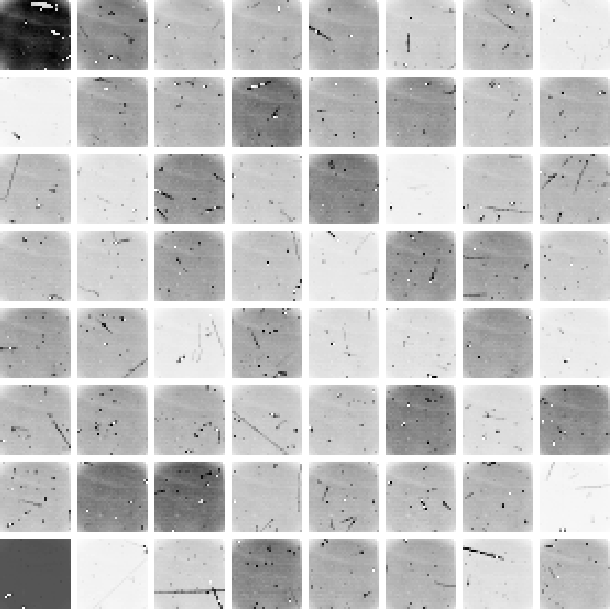
A library containing the most common glitches, as well as other
interesting glitches for illustration purpose, was built.
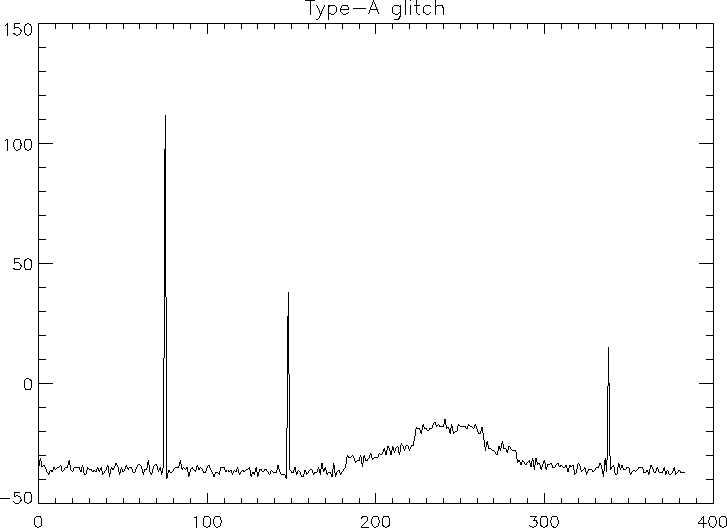
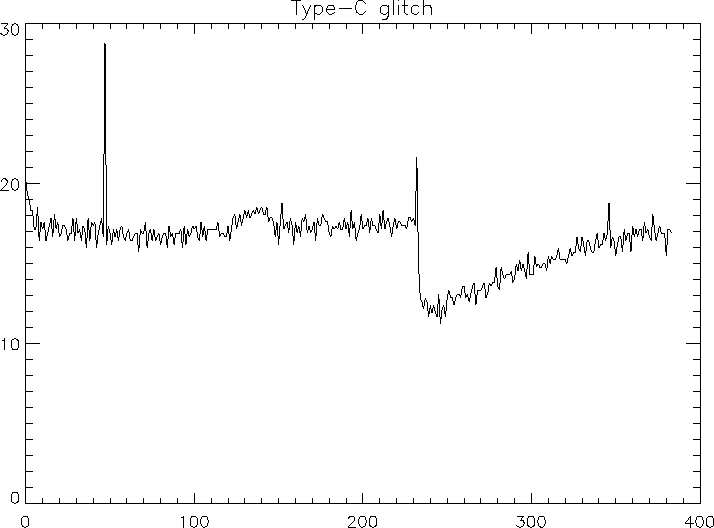
Glitches can be divided into 3 families based on their temporal profile.
Some other families could be considered taking into account the
origin of the glitch impact (proton, electron, heavy ion, ...).
Some glitches indeed display some extensions or a curved shape
(see Figure 1) depending of the nature and
energy of incident particle. Note also that there are probably low level
glitches, much more difficult to detect, but nevertheless affecting the
detector noise. Temporal families are given below:
Different types of glitches are saved in the IDL file
named
Structured variables contain a cube, mask and header fields (see below).
The header contains some informations about the origin of data, the
instrument configuration, and also IDL commands to display the interesting
part of data. The header is a 256-string array which can be updated.
Note that wheel positions are given in absolute values,
integration time in CAMTU, gain in physical value (gain=2 means that
the gain was actually 2 and not 22).
As an example, some IDL commands to display type-B glitch are given below. CIA> restore,'DKB0:[ACLARET.GLITCH.LIB]GLITCH_LIB.XDR',/verb
% RESTORE: Portable (XDR) SAVE/RESTORE file.
% RESTORE: Save file written by STATION@ISOW40, Wed Apr 8 17:37:53 1998.
% RESTORE: Restored variable: PROFILE_A.
% RESTORE: Restored variable: PROFILE_B.
% RESTORE: Restored variable: PROFILE_C.
% RESTORE: Restored variable: GLITCH_B.
% RESTORE: Restored variable: GLITCH_C.
% RESTORE: Restored variable: GLITCH_EOSW.
% RESTORE: Restored variable: GLITCH_REV722.
CIA> help,/struct,glitch_b
** Structure <9181d0>, 3 tags, length=993308, refs=1:
CUBE FLOAT Array[32, 32, 121]
MASK FLOAT Array[32, 32, 121]
HDR STRUCT -> <Anonymous> Array[1]
CIA> help,/struct,glitch_b.hdr
** Structure <918030>, 6 tags, length=2076, refs=2:
REV INT 721
CHANNEL STRING 'LW'
GAIN INT 2
TINT INT 36
WHEELS INT Array[6]
INFO STRING Array[256]
CIA> print,glitch_b.hdr.wheels
308 88 448 125 208 328
CIA> print,glitch_b.hdr.info
data provided by BA: ... / dedarked with interpolated dark /
type B glitch is visible from frame 19 till end of cube /
CIA> show_frame, glitch_b / CIA> tviso, glitch_b.cube(*,*,19) /
5. Miscellaneous
An interesting web page related to ISO glitches
has been built by Petteri Nieminen.
It is available at
(ftp://ftp.estec.esa.nl/pub/wm/wma/ISO/isoradiation.html).
6. Status Of Ongoing Work
There are two main objectives for the on going work about glitches. First
objective is to improve the glitch removal methods. At longer term, second
objective is to get as much as possible informations on glitches in order to
prepare next space experiments such as FIRST, PLANCK, INTEGRAL, ...
Improvement of glitch removal methods should be possible by deriving proper
statistics on individual glitches, in order to determine to which
family they belong, and then predict their temporal and spatial behavior.
Proton and heavy ions glitches can be easily removed from the observation by a
filtering technique. The worst problem is the responsivity variation after the
glitch, especially for heavy ions. A model of these effects is under
investigation. This seems mandatory for improving removal of type-B and type-C
glitches. The difficulty comes from the necessity of detecting glitches
individually, in order to build these statistics first, then model their
temporal behavior, and finally apply it to individually detected
glitches. We can reasonably hope that this will be fulfilled at least for
strongest glitches, even if the model concerns only a subset of all
glitches.
Around 1.5 hour of ISOCAM calibration time has been dedicated to the glitch
study (revolution 832 of Feb-24, 1998). The observing configuration was a bit
unusual, with an integration time of 1.12 sec (8 CAMTU), but observations were
carried out successfully4. This configuration was suited for
minimizing the number of glitches in ISOCAM images, in order to derive proper
statistics on individual glitches. With 1.12 sec integration time, a bit more
than 1 glitch/sec can be found in images. This minimizes the number of glitch
overheads. The key numbers given above (1 glitch/sec and 8 pixels/glitch) were
easily confirmed. The next step is much more complicated and requires a 3-D
analysis for glitch detection and statistics. Glitches are often removed
using the multi-resolution method which is based on a temporal criteria only. In
spite of being very powerful to remove glitch from ISOCAM data, this method is
not good enough to isolate glitches in a 3-D data cube. Thus, proper statistics
on individual glitch can not be derived yet, but this should be done in next
couple of months. New detection methods, probably very CPU-intensive, remain
to be developed.
Bibliography
Up: ISO Home Page Previous: ISOCAM Instrument Page 1998-06-30 |
| Copyright 2010© European Space Agency. All rights reserved. |
The RSSD Web Portal provides a single login facility to simplify access to several other applications within this site.
The login facility has detected that you have passwords to one or more of these other systems (Livelink, Mantis, CVS, etc.) which do not match your current LDAP password.
By clicking on [SYNCHRONIZE] you will be able to reset all these passwords and bring them into line with your main portal password with no further effort on your part.
Synchronizing Passwords - Please Wait
Logging In - Please Wait